
World Builder – The Alex Amancio Interview
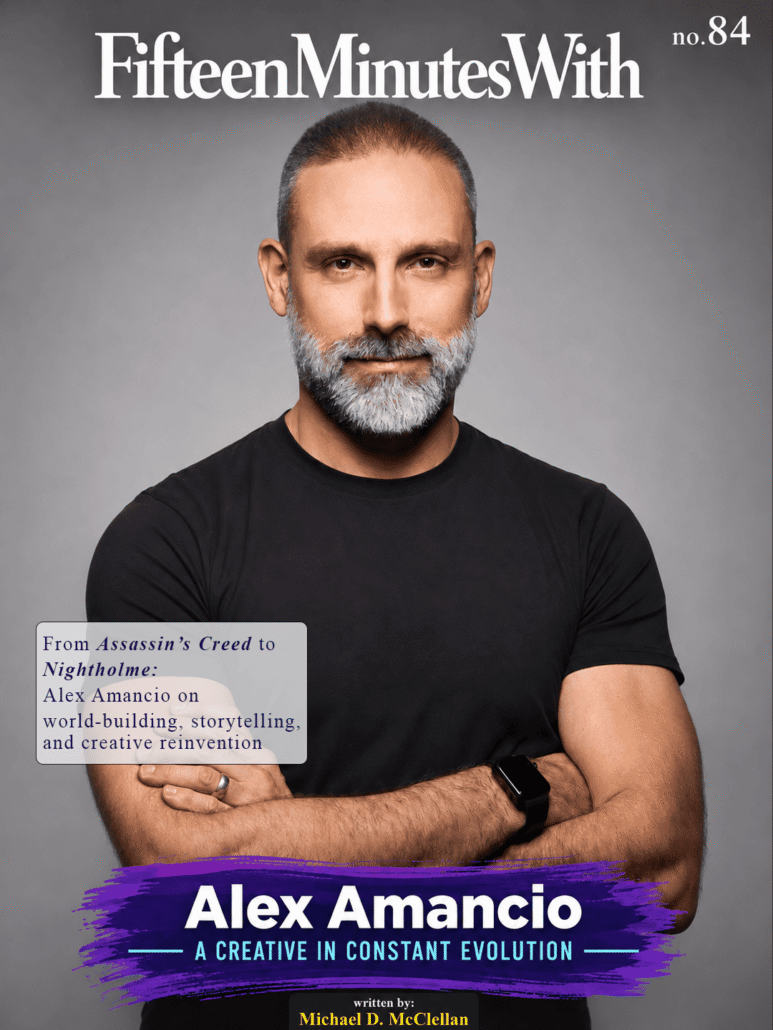
Written By: Michael D. McClellan
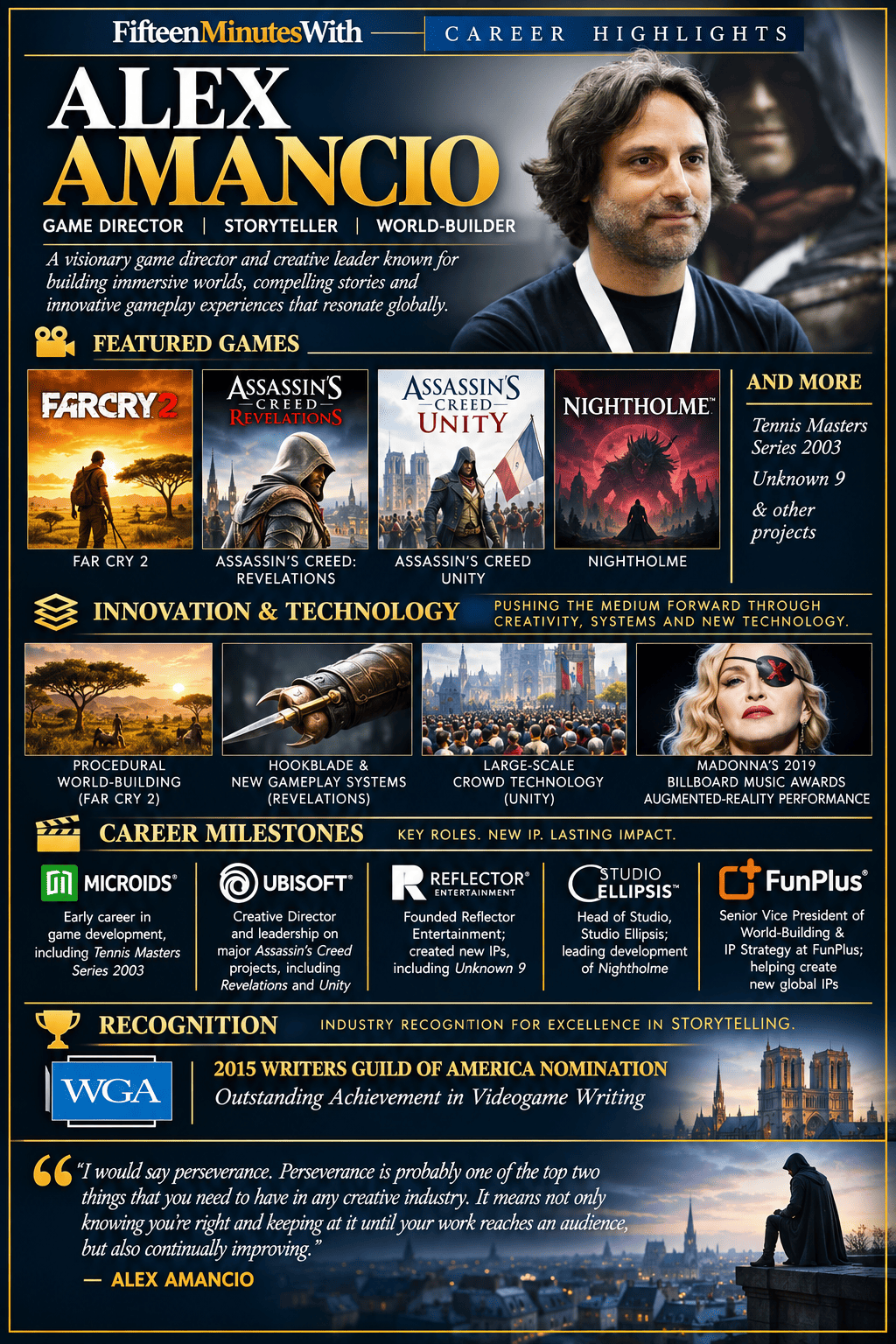
Alex Amancio is an evolutionary species. His protean nature has carried him along a remarkable journey, from aspiring physicist to creative director at Ubisoft to Head of Studio at Studio Ellipsis. Decades of mind-bending metamorphoses are evident throughout his career. His creative fingerprints can be found on Ubisoft’s Assassin’s Creed franchise, Madonna’s unforgettable performance at the 2019 Billboard Music Awards, and now Nightholme, a corrupted power fantasy game that’s all about—you guessed it—transformation.
“You take a potion, you turn into a monster to fight monsters,” Amancio says, “but in doing so, you’re also becoming that which you hunt. And if you’re not careful, you can lose yourself to that.”
Amancio got his start at a small indie studio, where he learned to wear many hats—a formative experience that has served him well throughout his career. His creative range soon found expression in projects such as Far Cry 2, where he served as art director, as well as Assassin’s Creed: Revelations and Assassin’s Creed Unity, where he was creative director. Along the way, he has led teams, co-founded startups, and built intellectual properties that keep us coming back for more.
“Yes, being part of a small team means wearing many hats,” Amancio says. “I had the privilege of learning to make games the hard way. I got to learn how stuff works. I couldn’t rely on other people solving problems, which meant that I had to dig down and try to figure things out for myself. It educates you in a whole different way. You start seeing games in a holistic way, and not just your own little lane.”
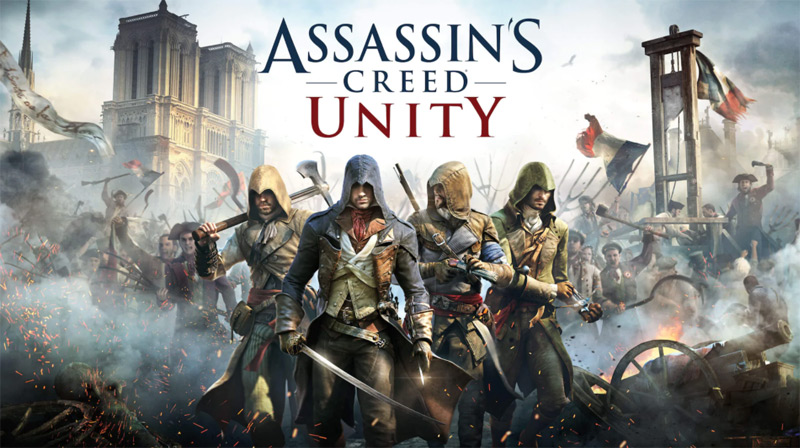
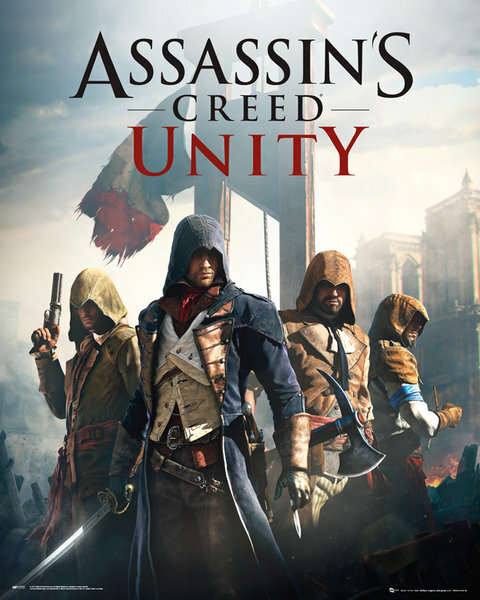
Assassin’s Creed Unity offers a compelling example of that philosophy in action. Set against the backdrop of the French Revolution, the game opens with the storming of the Bastille on July 14, 1789. Players step into the shoes of Arno, a native of Versailles and the son of an Assassin, navigating a Paris consumed by upheaval. The streets are caked with mud and stained with blood, the air thick with gunpowder smoke, and starving citizens crowd the city as the guillotines do a brisk business. The mission is to uncover the forces operating behind the Revolution, but the real achievement is the world itself—an immersive recreation of Paris shaped by pivotal historical events, including the execution of King Louis XVI, the assassination of Jean-Paul Marat, and the rise and fall of Maximilien Robespierre.
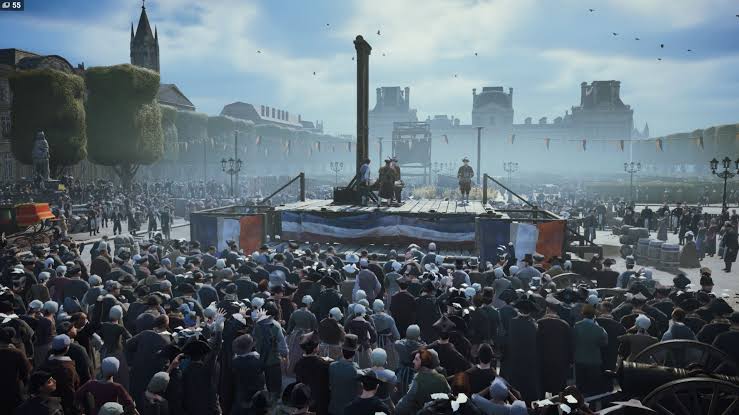
“I’m still proud of the work that we did on Assassin’s Creed Unity,” Amancio says. “I think that it’s still one of the most dynamic worlds that the franchise has seen. We had thousands of people on screen at one time. We had people breaking out into chants. If you went to the guillotine area, you could literally sit there for two hours and hear speeches of people being accused and then being executed before it looped again.
“Trying to make engaging worlds that are more than just dry film sets that look really good was the thing that motivated me when working on large, open world games. That was the case with Unity.”
The Portuguese-born, Montréal-raised Amancio has earned recognition from the prestigious Writers Guild of America for his storytelling abilities. Amancio was among the writers recognized by the Writers Guild of America in 2015, when Assassin’s Creed Unity received a nomination for Outstanding Achievement in Videogame Writing. His early career took shape at Microids, a small French gaming company where he served as creative director on Tennis Masters Series 2003—his first job in the industry.
“I had never played tennis before,” Amancio says, “so I became a very good tennis player by the time the game was released—at least on the computer. The real world is a far different story [laughs].”
When Microids closed its doors, Amancio and his colleagues were recruited by Ubisoft, paving the way for his creative leadership on Assassin’s Creed: Revelations and Assassin’s Creed Unity—projects that brought his work to the attention of audiences well beyond the gaming world. By 2019, Amancio had ventured into entrepreneurship, founding Reflector Entertainment and developing new intellectual properties and story worlds, including Unknown 9. His experience with augmented reality at Reflector would soon lead to an extraordinary collaboration. At the 2019 Billboard Music Awards, Madonna took the stage alongside four digital versions of herself in a groundbreaking performance that captivated audiences around the world. Reflector’s R&D team drew on its AR expertise to help bring Madonna’s vision to life.
“We had been experimenting with AR at Reflector,” Amancio says. “It’s a technology that overlays digital content—such as 3D models, text, and graphics—onto the real world in real time. We started brainstorming with Madonna’s team, and then it was just a question of figuring out how to get it done. From there, it was just executing it and crossing our fingers that it worked live.”
Madonna’s performance captivated audiences worldwide. Amancio, meanwhile, preferred to stay out of the spotlight.

“I was at home, on the sofa, waiting to see if everything went well,” he says, “while staying on the phone with the team in case something happened and they needed me. Thankfully, it went off without a hitch, and her performance received overwhelming critical acclaim. It was definitely a proud moment for everyone involved.”
Today, Amancio serves as Head of Studio at Studio Ellipsis and Senior Vice President of World-Building & IP Strategy at FunPlus. At Studio Ellipsis, his broader vision is to develop an interconnected suite of intellectual properties, with Nightholme at the center of that portfolio. A cosmic horror game, Nightholme explores corruption in its most disturbing form, examining the dangerous allure of power and the possibility of losing oneself to it.
“Absolutely power corrupts absolutely,” he says. “When you take on that power, you’re at risk of losing yourself. That’s the gist of what Nightholme is all about.”
One person not at risk of losing himself is Alex Amancio. He’s a man with a clear vision and a track record of success to back it up. That he’s willing to share his secret formula comes as no surprise to those who know him best.
“Perseverance,” Amancio replies simply. “Perseverance is one of the top things that you need to make in any creative industry, especially gaming. There are going to be rough times. There is going to be rejection. You’re going to doubt yourself. But you have to be willing to power through all of that in order to succeed. It sounds cliché, but failure is only failure if you give up. If you’re willing to persevere and you’re open to learning from those experiences, then you’re going to grow and you’re going to find success.”
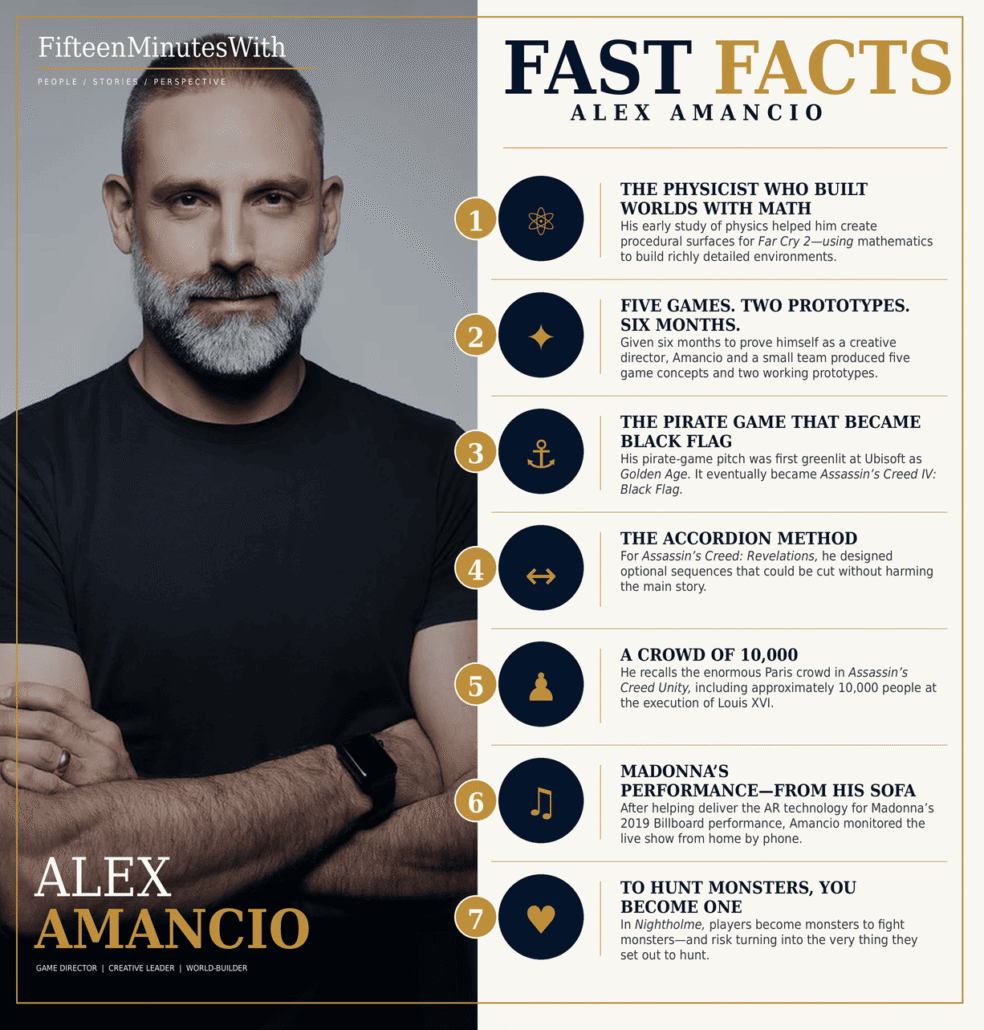
FAST FACTS: ALEX AMANCIO
Q&A
Michael D. McClellan
Alex Amancio is an acclaimed video game director and writer. He’s recognized for his expertise in transmedia storytelling and his acclaimed work on Assassin’s Creed. He is currently Head of Studio at Studio Ellipsis. Alex, thank you so much for joining us, and welcome to FifteenMinutesWith.
Alex Amancio
Thank you. I’m very glad to be here.
Michael D. McClellan
I’m so excited to talk to you again! I want to circle back and talk about your journey. You were born in Portugal and grew up in Montreal. What was life like for a young Alex Amancio? What did you do for fun?
Alex Amancio
When I was growing up, I played a lot of video games and I watched a lot of films. I was also kind of an explorer. I loved spending time outside and cataloging stuff. I built a terrarium so that I could capture insects and observe them. I guess you could say that I was curious. I was fascinated by everything.
Michael D. McClellan
You spoke Portuguese at home and French at school. You learned your third language—English—by watching TV shows and going to the movies. Do you think that language diversity helps you with your storytelling?
Alex Amancio
Oh, for sure. I was blessed with having Portuguese be my first language and then being immersed in French. My dad, it was his brilliant decision to say, “Look, all of the entertainment that we’re going to consume in this house is going to be English, so that you can be exposed to a third language.” I’m glad he did that. I think that learning multiple languages formats your brain in a certain way. I think that it makes the brain more ‘systems-focused.’ You understand that things can belong in boxes, and then you start noticing patterns between them.
Michael D. McClellan
At one point you considered a career in physics. What drew you to that field?
Alex Amancio
I think it was the same thing that drew me to being an explorer when I was a kid. I love watching things interact and understanding the interactions between them. I’ve always been kind of fascinated by the nature of reality and how things actually work—not the veil of reality that our brains process, but the underlying building blocks and mechanics of reality. How much deeper can you get than physics when it comes to the nuts and bolts of the universe?
Michael D. McClellan
If you had gone down the physics path, would you have been a theoretical physicist or an experimentalist?
Alex Amancio
Probably a theorist, though I have tremendous respect for experimentation. I like thought experiments. I remember as a kid lying in bed, eyes open in the dark and just letting my brain wander in different directions. What happens in deep space? How did all this get started? It’s something that I still do to this day.
Michael D. McClellan
Did you watch Oppenheimer? As a storyteller, what did you think of the film?
Alex Amancio
I thought it was fantastic, but I might be biased because I’m a huge Christopher Nolan fan. I think that movie was quite elegantly made. I love the perspectives, the way it was put together. The acting was fantastic, and the story was fascinating. It was a beautiful piece of storytelling.
Michael D. McClellan
Let’s talk about your career—I’m going to call this chapter “Ubisoft 1.0.” You applied for a job there when they landed in Montreal, but you didn’t hear back from them. Did this turn out to be a blessing in disguise?
Alex Amancio
Yes—you’re absolutely right, because I ended up working in a very small studio instead. It was a French company called Microids, and they had about 80 employees working on three projects. The biggest project involved 30 people. I was on a team of 12. Being part of a small team means wearing many hats. I had the privilege of learning to make games the hard way. I got to learn how stuff works. I couldn’t rely on other people solving problems, which meant that I had to dig down and try to figure things out for myself. It educates you in a whole different way. You start seeing games in a holistic way, and not just your own little lane.
Michael D. McClellan
There are certainly people who are hyper-focused and become very successful. However, some of the most successful people who have climbed to the top have swept the floors, cleaned bathrooms, and learned every aspect of the business. How did that indie job help shape your career arc?
Alex Amancio
We all experience the world as individuals, which means that we tend to put ourselves at the center of everything. I’m not talking about narcissism. The way we process the world is that we often communicate from our perspective, because that’s the only perspective that we truly know. But one thing you learn, especially in a game development environment, is that different traits have very different perspectives on the game. Learning various tasks allows you to understand the reality of that department, of that person, of that discipline, etc., and it allows you to shift focus when you communicate with that team, to speak the same language, if you will.
I find that a lot of the misalignments that happen in video games—which is why making new IPs is such a hard thing—happen because we rely on a lot of assumptions. And when you’re coming in from a certain trait, those assumptions might not be the same assumptions as the person that you’re talking to. Having at least touched upon a lot of those different traits allows one to shift perspective and use the words and the references that are useful to that trait. I think that eliminates a large portion of the miscommunication during development.
Michael D. McClellan
Does empathy play an important role in leading teams?
Alex Amancio
Yeah, totally. I think empathy is something that you inherently pick up from life in general. I have to say that the older I get, the more empathetic I tend to be. It’s not even a question of being able to put yourself in somebody else’s shoes. It’s being able to keep your own drive and ambitions in check.
Michael D. McClellan
Can drive work against you if you’re not careful?
Alex Amancio
A lot of times—and this goes with youth—you want to sprint to the destination. Sometimes you forget that it can be much more efficient to go a little slower and have people come along on the ride and do it together. There will be obstacles where maybe you need a boost, or you need to boost somebody up. And even if you do sprint alone, you inevitably run into that insurmountable wall that you could totally overcome if you were more than one person. So, I think that comes with time and experience. It’s more about learning through past mistakes and through past challenges. Life is a team sport, right?
Michael D. McClellan
One of the first games you developed was a tennis game. What did you learn from that experience?
Alex Amancio
I served as the creative director on Tennis Masters Series 2003. I had never played tennis before, so I actually learned the various technical aspects of tennis during this project. And I learned to play tennis on the computer very well [laughs]. That was actually my first game job ever. I had a lot of fun, even though it wasn’t the most interesting project at the company from a developer’s perspective. When I stepped in, the team was a little bit down, but I have to say that by the time we ended that project the morale was very high. I don’t think anybody on that team would have wanted to leave until the project was complete. It just goes to show you that when you find the right people working together as a team, it’s not necessarily what you’re working on. It’s more about the experience that you have while doing it.
Michael D. McClellan
How did working at an indie studio help prepare you for the Assassin’s Creed franchise?
Alex Amancio
I was the creative director on the Assassin’s Creed franchise, and in that position, it’s critical for you to be able to express a vision in a way that the team understands. Again, going back to having worn many hats while working on a small team, it really does allow you to learn the vocabulary of the different disciplines. I’ve certainly witnessed mistakes in the past, and I’ve made those same mistakes where I’ve attempted to deliver a unified speech for a vision. But the truth is, your pitch is only as good as it is adapted to the audience. If you’re not adapting it and adjusting it, the pitch is more likely to fail. For example, something that might land very well with marketing might feel like a sales pitch to tech people. The tech people might come out of it and say, “Well, it’s just a lot of BS,” and then turn a deaf ear and not buy in. So, I think having worn all those hats allowed me to really figure out ways of adapting my vision when communicating with each different department, which in turn allowed me to maximize understanding.
Michael D. McClellan
What was the biggest skill that you brought with you to Ubisoft?
Alex Amancio
I brought a lot of things that I learned at the indie studio with me to Ubisoft. I think the biggest one was this broad perspective, this idea that when you have a small team, every potential problem can undermine the whole project. A very clear analogy would be if you’re looking at a table and there’s a bunch of people eating, and there’s a mug sitting right on the edge of the table. The mug is one nudge away from falling onto the floor and shattering into a million pieces. In a big studio, everybody tends to have their specific role. If something is going to hit the floor and it’s not related to your specific job, you don’t pay attention to it. In an indie studio, when you see that mug on the edge of the table you’d better move it. Otherwise, odds are next time you look it’s going to be on the floor, broken. So, you tend to tackle it. That’s what I tried to bring with me to Ubisoft. So even on a big project, being able to take ownership and go beyond the silo is indispensable.
Michael D. McClellan
The popularity of the gaming industry has exploded, in part because of iconic games like Assassin’s Creed, which have become huge in pop culture. Today you see athletes like Max Verstappen, Karl-Anthony Towns, or even Neymar streaming their gaming experiences to the world. What part did you play in this shift?
Alex Amancio
Games have become huge, no question. I think I played a very, very humble part in that evolution, along with a lot of people that I worked with at Ubisoft Montreal. I remember a time, back in the day, when open world wasn’t a thing. You had games with bigger levels, but the term “open world” didn’t really exist. The first attempts at real, open-world environments happened simultaneously in many different places, but I think that a lot of it was happening at Ubisoft in Montreal.
Michael D. McClellan
What was your first project at Ubisoft?
Alex Amancio
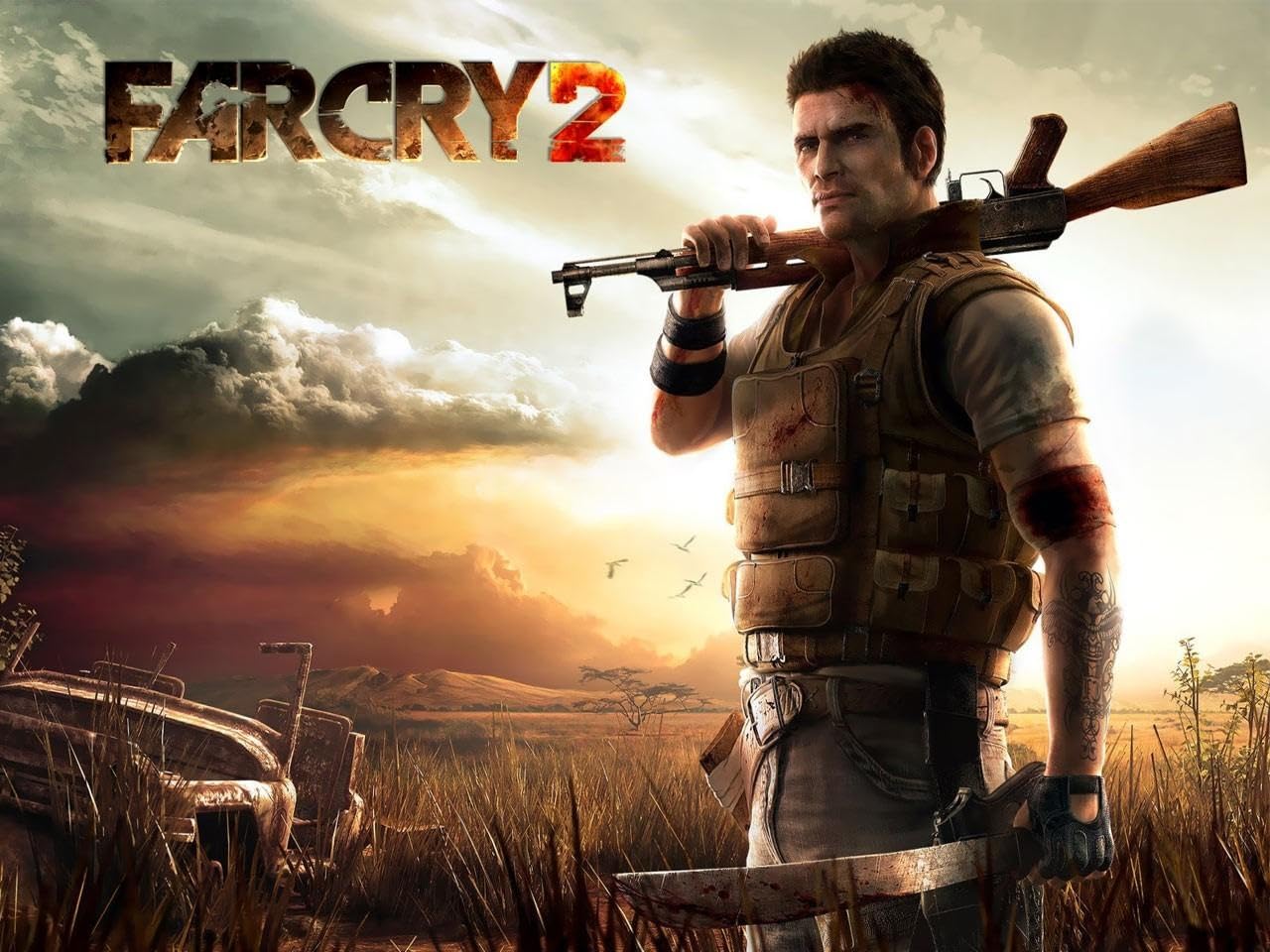
My first project at Ubisoft was Far Cry 2. My indie studio had shut down, and Ubisoft scooped all the employees. So, that’s how I ended up at Ubisoft. They scooped up everything [laughs]—they got the desks, the furniture, right on down to the employees. I found myself packaged with the desks and chairs and the rest of the folks over there. I was very grateful for the opportunity, don’t get me wrong, but I was put on Far Cry 2 before ever having met the team. Actually, it turned out to be a team that had never worked together. The executive producer told me, “Here is how I want this game to look,” and he showed me Crysis on his screen. He said, “I want Far Cry 2 to look as good as that.” I was like, “Yeah, but that game’s running on a $6,000 computer. We need Far Cry 2 to run on an Xbox 360.” He shrugged his shoulders and said, “Well, that’s your problem.”
Michael D. McClellan
How did you approach solving your Far Cry 2 problem?
Alex Amancio
I knew that I couldn’t use brute force, so I had to be clever. This is where my physics background came in. I tried to figure out the simplest way of creating a very beautiful world using the least amount of resources. Textures are like paintings that you apply to a 3D image so that the image looks very high-resolution—take a wall, for example, maybe one made out of wood. The tradeoff is that a high-resolution wall costs a lot of memory, which the Xbox 360 didn’t have a lot of. But what the Xbox 360 did have was a lot of processing power compared to most computers back then. I thought that if processing power is my advantage, and not necessarily memory, then instead of using textures, why don’t I try to simulate the surfaces? So, I created the surfaces out of math. For example, if you render clouds in Photoshop, it just renders a random cloud. If you take that cloud and you smudge and squish it, then you discover that it starts looking like tree bark. It just happens that the tree bark is a fractal squished onto a cylinder. And because all of these surfaces were done with layers, it meant that I could blend one layer to another. So, my contribution, if you will, at least at that scale, was figuring out how to build large, systemic, procedural worlds that interacted with physics and that could dynamically evolve.
Michael D. McClellan
What was it like making the transition from Far Cry 2 to the Assassin’s Creed franchise?
Alex Amancio
I’m proud of my small contribution to Assassin’s Creed. I had the privilege of standing on the shoulders of the giants that came before me, the ones that laid the foundation of that IP. Coming from Far Cry, I always had a love for the systemic nature of things. I still feel proud about the work that we did on Assassin’s Creed Unity. I think that it’s still one of the most dynamic worlds that the franchise has seen. We had thousands of people on screen at one time. We had people breaking out into chants. If you went to the guillotine area, you could literally sit there for two hours and hear speeches of people being accused and then being executed before it looped again. Trying to make engaging worlds that are more than just dry film sets that look really good was the thing that motivated me when working on large, open-world games. That was the case with Unity.
Michael D. McClellan
I have a pop culture question for you. You’re stranded on a deserted island. You can only have one album, one book, one TV show, one movie, and one video game. What would your choices be?
Alex Amancio
You started with album. This has changed throughout my life, and I would probably have answered with something different five years ago. Right now, my album choice would be Blood on the Tracks by Bob Dylan. My book would have to be The Lord of the Rings. The movie is a tough one, because it’s probably a tie between three different films—or four, or five different films. It would come down to Chinatown, Blade Runner, Fight Club, The Empire Strikes Back, and The Godfather.
Michael D. McClellan
Great choices—we can definitely hang out on the same island! How about your TV show?
Alex Amancio
That’s also a tough one. It would probably come down to either Battlestar Galactica or The Sopranos. Breaking Bad is another one. And if I could only choose one video game, it would have to be Elden Ring.
Michael D. McClellan
Why Elden Ring?
Alex Amancio
It’s brutally tough, and it trusts the player’s intelligence in finding their own path. There’s a lot of stuff to discover. There’s a lot of stuff to master. I’m also a Dark Souls fan. I had never played Dark Souls III, which I’m playing right now on PlayStation 5, and there’s just something about the game that I love. And again, had you asked me this five years ago, I probably would have a different opinion. There are other games that I think are just as brilliant. I think that The Legend of Zelda: Breath of the Wild is a spiritual successor to Far Cry 2. It’s got a lot of the same philosophies behind it, particularly in the way the world is built and in the way that the systems interact. I like Oblivion more than Skyrim and Fallout. There’s just so many games that I can go way back and talk about.
Michael D. McClellan
Do you have a cult favorite video game from back in the day?
Alex Amancio
One completely obscure game that probably nobody’s ever heard of is a game called Starflight 2. The entire game was just one screen, with one interface. You’re in a spaceship and you have a crew, and you’re exploring a procedural universe. You can orbit systems like stars. You can go to planets. You can mine for resources. There’s all these different alien species that inhabit the entire universe. You need to train your communications officer, or else the language is just gibberish. You don’t understand what they’re telling you at the beginning. They might attack you because you did something wrong, or you didn’t understand what they were saying. The entire game fit on a floppy disk. Other better-known old-school games include Zelda, Metal Gear, and Baldur’s Gate. I loved RPGs, especially back then.
Michael D. McClellan
What was it like transitioning from the art director role on Far Cry 2 to being the creative director on Assassin’s Creed: Revelations?
Alex Amancio
I had just finished Far Cry 2, and I was trying to figure out what I wanted to do next. The core team for Far Cry 2 split in half, even though everybody got along really well. Actually, we were all very good friends. One person moved into creative direction, and on that same team, the technical director moved into production. So, they started a core team of their own and went on to create Watch Dogs. The other half, which included the producer, the creative director, and me, had this idea for a new IP based on superheroes. This was a little before the first Iron Man movie came out. We wanted to create a really systemic city where superheroes interacted organically. It was a co-op game, and we wanted the powers to be complementary. We spent a lot of time designing the characters, designing the powers, things like that. We had this amazing breakthrough, which was we wanted the game experience to generate a comic book—and not just screenshots. We wanted to create a system that literally would create something that looked and felt like a comic book based on your experience in the game. And if I shared mine with you, for example, and you clicked on a panel, it would zoom in and now you are able to play it. And if you continue from there, then it’s my comic with you in it. After a year of collaboration, we had a working prototype, but Ubisoft decided not to pursue it. The reason back then was that they just didn’t believe that the superhero genre would ever be mainstream. I think the phrase they used was “marginal.” Like, “It’s marginal in North America, and it’ll never be anything in Europe.”
Michael D. McClellan
That seems like a big swing and miss on Ubisoft’s part.
Alex Amancio
They say that hindsight is 20/20, but at the time their decision made sense. Who knew the Marvel and DC cinematic universes would have become so big? I mean, we thought so because we were huge comic book fans, and that’s why we were pitching the idea. But it just might have been that we were completely biased because we love comic books so much.
Michael D. McClellan
The door on your comic book idea may have shut, but another door opened.
Alex Amancio
The creative director on the project had given me a lot of breadth to collaborate with him on the creative side, and I liked it. When the project didn’t pull through, I was looking for something to do. I thought about moving into creative direction because I thought I could do it. The leaders at Ubisoft were fantastic. What they did was say, “Okay, you’re going to have to prove to us that you’re able to do it.” For me, that was great. I love stuff like that. It was a challenge. It put the burden on me, as it should have been, because I was the one who wanted to change jobs.
They assigned two game designers and three engineers to me, and we created a team. We had one room on the fourth floor. I remember that we needed a badge to get in. They locked us in there for six months with one edict: “Show us what you can do.” So, the team and I spent that time building a few prototypes.
Michael D. McClellan
What gaming prototypes were you able to produce in those six months?
Alex Amancio
Instead of just pitching one game, I had five games and two working prototypes. One was a platformer. Back in the day, Nintendo was talking about the possibility of having a console that, like an iPad, you could actually draw on. So, I envisioned this game where you could play a platformer with your kids. The child would be playing the character—imagine playing Mario—and you would be drawing physics objects. You might have a character performing tricks on a skateboard. If you want your character to jump, you draw a skateboard, and then the physics work the way it should when you’re on a skateboard. You draw a shield around the character and you’re able to protect the character. We had that prototype working.
Another one was an AR game. We had a webcam, and you could play Assassin’s Creed on the tabletop, and it was all played like a board game. The assassins would run. You would move QR codes around, and the assassins would kind of do missions. That one was also working. I also had a third-person action-adventure title set in a magical world, as well as a pirate game. Pirates are always cool. There hadn’t been a really good pirate game in a long time. So, one of them was a pirate game.
And so, I pitched these games to all of the executive producers at Ubisoft. The executive producer from Assassin’s Creed said, “Look, Ubisoft should make all of these games, but I don’t think we’re going to do it because there’s so much stuff on our plate. What I can tell you is we want you to come over to the Assassin’s Creed brand. We have a tough mission for you when you come on board, but prove yourself on this, and then you can do the big one that we’re planning for the next few years.” That first project was Revelations. The caveat was that Ubisoft needed to ship it in 10 months. The other caveat was that a team for this project didn’t yet exist. So, putting together the team became the first mission.
Michael D. McClellan
How did you deliver Assassin’s Creed: Revelations in less than a year?
Alex Amancio
I had a partner in crime. For the producer working on this project, Revelations also happened to be his first job as a producer. Also, Ubisoft didn’t really ask for a game. What they asked for was a mission pack. And when we sat down together to scope the game, I looked at the producer and said, “Look, if we stay focused and we decide what we’re going to tackle creatively as challenges, and stick to it no matter what, and if we design this in an intelligent way—and I’ll tell you about the strategy behind that—I think we can pull this off.”
We went to Paris to pitch to editorial and to corporate, and we had the mission pack. The mission pack was done in a way where it was so close to a full game that they couldn’t help but ask the question, “This looks almost like a full game. Why couldn’t this just be a full game?” My response as I moved to the next slide in the presentation was, “Interesting that you should say that. Of course! Here it is!” And that’s how we pulled it off. It went exactly as planned.
Michael D. McClellan
How did you and your team tackle bringing Assassin’s Creed: Revelations to life?
Alex Amancio
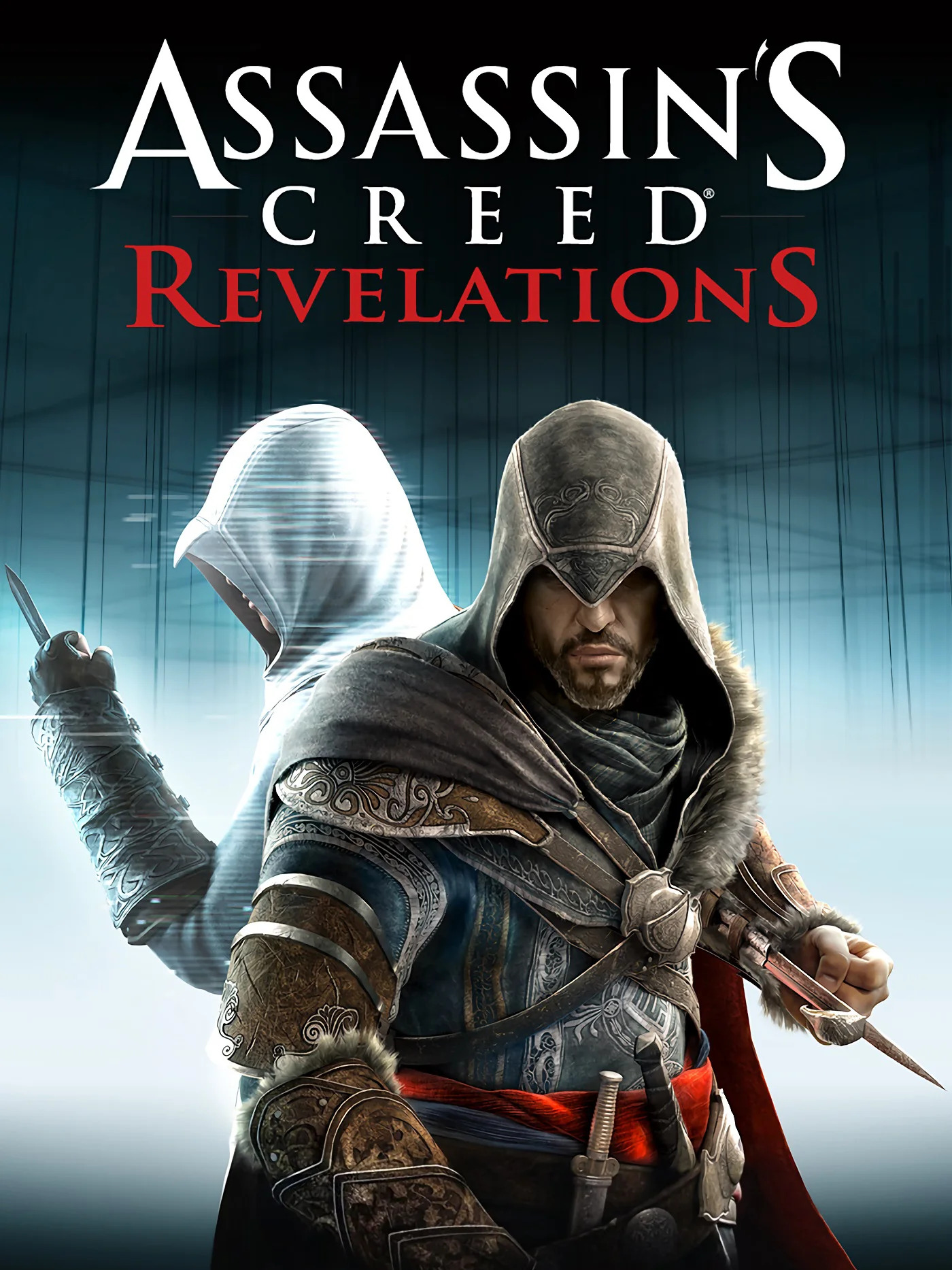
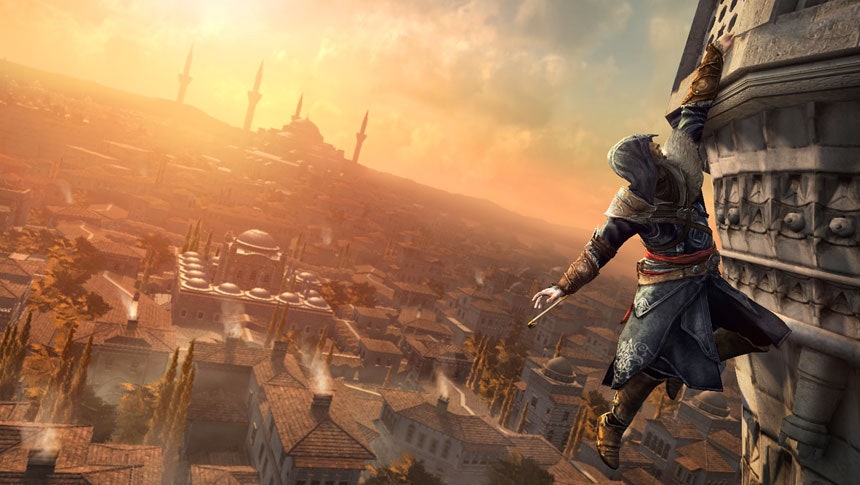
I felt that if we could achieve three game design breakthroughs—ones that tackled the core pillars of Assassin’s Creed—fans might perceive it as enough. So, number one was navigation. Navigation was becoming tedious because buildings were becoming higher and higher, and the navigation speed wasn’t changing. The metrics for climbing were 30centimeters. So, I had this idea. I’m like, “What if we could double that?” My original idea was actually a chain that you would use to climb up faster. The chain could also be used by the player to swing. And I think that Syndicate actually ended up doing something similar much later. But the chain idea proved to be unfeasible. So, the next best thing was the Hookblade. The Hookblade was a 30-centimeter hook on your assassin’s blade that allowed you to double your climbing speed. And then, because we had the Hookblade, we were able to incorporate zip lines like highways. So that was number one. If we innovate in navigation, it will be perceived as something tangible.
Then it was about the crowd. The crowd is one of the core things in Assassin’s Creed, and yet I thought it was very reactive. We had all these levers; as the developers, we could make the crowd gather, disperse, move. So, what if we gave this power to the audience, to the players? This was the bomb system, the crafting system; a player could use a coin bomb to have the crowd rush in, or a stink bomb to have them disperse. So, it was all ways of manipulating and giving more tools to players to play with the systems that already existed.
Lastly, Assassin’s Creed was still a very standard third-person game, and I felt that if we created a more tailored narrative experience, it would boost the immersive experience. So, we scripted the camera more. You notice it a lot of times, but sometimes you don’t. We did subtle things with the camera to bring you in and increase your immersion. This was really the first Assassin’s Creed game where we were doing that stuff in the game as you were playing, not in cinematics.
Michael D. McClellan
From what I’ve read, you also got creative with the plot.
Alex Amancio
I figured that if we positioned this as the end of a trilogy, and the last story in a trilogy, no holds barred, anything can happen. So, this will make it very interesting if we twist this as the culmination of this beloved character’s story. And then, as an extra benefit, why don’t we add flashbacks featuring Altaïr, the original character from the series? At that moment we knew—this is all we need. Everything that doesn’t fit within these predetermined targets we ignore, and we just focus on that part.
And then for added safety, I employed another trick that I like to call ‘the accordion method.’ And that is, you find a place in the game that you can contract where nobody but you will know it was contracted. So, in our case, it was the Altaïr scenes. The flashbacks. We added five so that we could have a scope that’s as big as possible. If we ran out of time, then we could cut these sequences because nobody knew how many we’d planned in the first place. Whether we shipped the game with three, five, or 10, no one would know except our team. We ended up shipping with three, even though we had originally planned five. Nobody was the wiser. So, when we ran into trouble, that was the first thing to hit the chopping block. The alternative was removing elements from the story. When you remove elements from a cohesive, linear story, you start getting plot holes. The progression isn’t elegant anymore. It feels like your tension curves are all in the wrong place. Whereas these were kind of reward missions that, in themselves, were kind of self-contained. Removing one would not change the overall experience.
Michael D. McClellan
Revelations was a huge commercial and critical success. Suddenly, you are tasked with a far bigger project: Assassin’s Creed Unity.
Alex Amancio
Unity was the exact opposite, in almost every respect, in terms of the challenges we faced. With Revelations, we had a very, very tight time constraint and we had a very limited budget and team. Unity was the game that Ubisoft really wanted to be proud of, and production of the game had already begun. The budget was bigger, the team was bigger, and the timeline was not as aggressive. Along with it came enormous expectations.
Michael D. McClellan
Did you go straight from Revelations to Assassin’s Creed Unity?
Alex Amancio
When we finished Revelations, our team was assigned to a project called Golden Age. The producer and I flew to Paris to pitch my concept, and the presentation validated our hopes—Golden Age was greenlit on the spot. Golden Age ended up shipping under a different name: Black Flag. That was the pirate game that I had been pitching.
Michael D. McClellan
Assassin’s Creed IV: Black Flag is widely considered by gamers and critics to be one of the greatest pirate games ever made.
Alex Amancio
It’s really funny because, within Ubisoft, there are three competing origin stories of where the pirate game idea came from. My theory is that we all did. The thing is, when something is ready in the zeitgeist, the idea will just converge. That’s what happened with Black Flag.
Michael D. McClellan
What do you remember most about becoming the creative director for Assassin’s Creed Unity?
Alex Amancio
The Unity project had already started, but they didn’t have a creative director. It was such a huge project, and Ubisoft’s ambition and expectations were enormous, so I was asked to join the project and help make it happen. The only thing that was known when I joined the project was that it was going to be set in Paris. The next thing they said was that they didn’t know when. They wanted to set it in one of five time periods: The Middle Ages, the French Revolution, Victorian times, the early 19th century, or the German occupation. My first challenge was bringing the scope back under control. After much deliberation, we decided to go with the French Revolution.
Michael D. McClellan
Why did you decide to set Assassin’s Creed Unity during the French Revolution?
Alex Amancio
Paris is such an iconic city that it’s difficult to choose one period that captures everything. If we went with the French Revolution, we knew we would sacrifice the Eiffel Tower, which was built 100 years later. But if we did World War Two, that means guns. It really changes Assassin’s Creed when you have machine guns. It becomes a different game. So, what do you do? The idea was to control the scope: go back to an iconic period and make the crowd the star again, make the city the main character. So, we figured out a way to scale the crowds. I think the biggest crowd we have in the game is during the execution of Louis XVI. I think there are around 10,000 people—no other game has even gotten close to that.
Michael D. McClellan
How were you able to pull that off?
Alex Amancio
The technology behind the crowd is just insane. The engineers who pulled it off made the crowd behave like fluid. When you look at the way water moves—for example, if you increase the size of the atoms until they’re beads—it moves the same way. In our case, those beads were individual humans, and as soon as you got close enough or interacted with them, an AI got spawned, and that bead moved based on mathematics. It also spawns a mind, and then it becomes an AI. But all of that—the way it’s handed off and handed back into the fluid—is just so mind-boggling to think about. That was the challenge; developing a next generation engine—the biggest one that had ever been built—and making it co-op and doing all of that with the very little time we had left.
Michael D. McClellan
What was the timeline to bring Assassin’s Creed Unity to market?
Alex Amancio
We had about two-and-a-half, maybe three years. But considering the scope and the ambition of the game, that was very tight. The main challenge was trying to control that scope without sacrificing the ambition of the game. Unity was released in 2014. Even by today’s standards, it’s still an ambitious title.
Michael D. McClellan
What are you most proud of when you reflect on each project?
Alex Amancio
For Revelations, I have to say it’s the team. That team was made up of incredible people that got along really well together. It was almost miraculous how that team coalesced. At Ubisoft, there was a certain serendipity in the air when that team was created. If you look at how Revelations turned out, I think it’s a testament to the quality of that team.
With Unity, what I’m most proud of is the city. I’ve always thought that Assassin’s Creed was a very static game in the sense that it’s a single-player, linear game hidden within an open-world structure. That’s the way that I’ve always perceived it. There was very little I could do about that in Revelations, given the timeline, but I really tried to push it as much as I could in Unity. I didn’t want to make the city into a beautiful but very austere film set. I wanted it to be something that really felt lived-in, something that you could actually interact with. Assassin’s Creed is about historical tourism. Historical tourism is at its best when it really does feel like you’re visiting a real world and not just a film set.
Michael D. McClellan
Let’s talk about your time at Reflector Entertainment, where you explored new IPs and story worlds, including Unknown 9.
Alex Amancio
Reflector was my first foray into entrepreneurship, so there was an adjustment in going from being a creative director at Ubisoft to trying to build a company from the ground up. Most of the lessons that I learned were about the pitfalls and opportunities that happen when you try to create something from nothing. You start experiencing issues and encountering other factors that you need to take into account—things that aren’t part of the equation when you’re just worrying about the creative side. In a sense, it’s the truth and the reality that every indie team has to deal with. We just had to deal with it on a bigger scale.
Michael D. McClellan
What did you enjoy the most about your time at Reflector?
Alex Amancio
By the time I left Reflector, it had grown to 150—160 people. We also had COVID to navigate. So, it was probably one of the biggest learning phases of my career. I’m so proud of all of the stuff that we did during my time there. For example, we started a podcast that I think is still one of the best narrative podcasts out there. You can still listen to it on Spotify or iTunes. I enjoyed collaborating with some really amazing creatives, including Leighton Greene, who created a novel trilogy that I think is an incredible mixture of science and the supernatural. So, yeah, it was an extremely enriching and very intense part of my career.
Michael D. McClellan
Let’s talk about the 2019 Billboard Music Awards. Madonna appeared onstage alongside four digital versions of herself in a groundbreaking performance—one you were chosen to help bring to life. What was it like working on a project with such a massive global audience?
Alex Amancio
It was super interesting, although I never factored in the audience or the scale of it. That would have introduced a pressure that we didn’t need. For me, it was more about, “How the heck are we going to pull this off?”
Thankfully, we had a small R&D department at Reflector. It existed because I felt that things were changing so fast that we needed to keep an antenna tuned to that innovation. I think the advantage that smaller studios and companies have over huge ones is their ability to disrupt, and disruption often arrives through technology. I mean, you don’t have to go very far to look for an example. Think about Blockbuster and Netflix, and how technology completely subverted an established business model. So, for that reason, I’ve always wanted to have my antennas tuned into the emerging stuff.
Michael D. McClellan
How did you end up working with Madonna?
Alex Amancio
The way the project came about was interesting. I was contacted by Madonna’s manager, who I knew through a mutual friend. We had spoken a few times, and at one point he called me up and said, “We’ve been wanting to do something together. Madonna is going to be doing the Billboard Awards. Is that a good enough proposal for you?” So, I had a meeting with the people in that small department at Reflector. We had been experimenting with augmented reality. AR is a technology that overlays digital content—such as 3D models, text, and graphics—onto the real world in real time. Unlike virtual reality, which replaces your surroundings, AR enhances your physical environment by bridging the gap between the digital and physical realms. We had been working closely with a few companies that were developing AR back then, so we just started brainstorming. At one point we connected with the team on Madonna’s side, and we came to an alignment on what both sides wanted. Then it was just a question of figuring out how to get it done, including finding partners that could fill the technological gaps we had. From there, it was just executing it and crossing our fingers that it worked live.

Michael D. McClellan
Where were you when Madonna performed Medellín at the 2019 Billboard Music Awards?
Alex Amancio
I was in Montreal. I had the opportunity to go there during the recordings and scanning—we had to scan Madonna’s body and face—but I was so busy with other things in Montreal that I didn’t go to Vegas. I was at home on the sofa, waiting to see if everything went well while staying on the phone with the team in case something happened and they needed me. Thankfully, it went off without a hitch, and her performance received overwhelming critical acclaim. It was definitely a proud moment for everyone involved.
Michael D. McClellan
You’ve been recognized by the industry for your storytelling. What does that mean to you?
Alex Amancio
It’s always flattering when you get recognized in anything like that. Remember when we started, I used the word “explorer.” I really do see myself in the same way. Whether it’s art or science, whatever we’re doing, there’s a kind of alignment you can achieve with the universe when you’re doing something you love and operating at a level that’s right up there. You almost feel like there’s a synchronicity. I have no other way of qualifying it other than excellence. You can kind of see it, almost taste it, almost touch it, but not quite. The pursuit of that feeling is the thing that motivates me.
I love storytelling because it’s such a human trait. It’s both elegant and simple, yet it’s also the most complex thing that I’ve ever experienced. When you’re creating a story from scratch—creating characters, creating a world—you literally have infinite choices, infinite possibilities. The level of complexity is so great that you quickly learn that making something that feels simple and elegant is the hardest thing in the world. The pursuit of that excellence and trying to always be better is really what motivates me more than recognition.
Michael D. McClellan
If I’m building a Mount Rushmore of gaming, I’m carving Alex Amancio’s likeness on it. I need three more people. From your perspective, who would they be?
Alex Amancio
Oh, my God, there are so many names. Legends like Sid Meier, who is probably best known for creating the Civilization franchise in the ’90s, or Will Wright, the creator of iconic simulation franchises like SimCity, The Sims, and Spore. There’s Hideo Kojima, who is an absolute legend. Kojima brought us Metal Gear, among other great achievements during his career. If we’re talking about storytelling, Neil Druckmann has to be up there. What Druckmann has accomplished at Naughty Dog, including co-creating The Last of Us, is absolutely phenomenal.
There are also so many people I’ve worked with throughout my career whom I have tremendous respect for—people like Clint Hocking, who I worked with on Far Cry 2. My appreciation for a systemic approach to game design is due in large part to Clint, because I saw him use that method as creative director at Ubisoft. So, yeah, I’m very lucky to find myself in an industry with so many inspiring people, past and present, that are still pushing the envelope today.
I would also say that there are so many people that I couldn’t even name because they’re operating at an indie level, and they’re pushing the limits of the medium, pushing it to the point that I think we’re entering a new phase of the industry. Today, you don’t need money or a big team to create something incredible. There are so many I can’t name who should also be on that Mount Rushmore. Maybe we should carve a blank face that represents the indie developers. Put them up there in my place. I’d prefer to be on the ground, looking up and admiring these great people.
Michael D. McClellan
Let’s talk about your new business venture. You’re Head of Studio at Studio Ellipsis and Senior Vice President of World-Building & IP Strategy at FunPlus. What inspired you to take this next step?
Alex Amancio
Studio Ellipsis is the realization of my desire to go back to my roots. Remember when I was talking about the precarious mug analogy? Studio Ellipsis is a return to the small-team environment from earlier in my career, with people focused on being hands-on and taking a more direct approach to development. As I evolved in my career, I saw the Montreal gaming industry go from very, very small to one of the biggest hubs in the business. That transformation led to a lot of positive things, but I saw a trend of people becoming a little bit more blasé. Games were becoming so big and teams were becoming so large that the industry was becoming impersonal. So, Ellipsis was a way for me to rediscover that passion and surround myself with a bunch of people who were as—if not more—passionate than I was.

Michael D. McClellan
Your team at Studio Ellipsis is hard at work developing its first IP. Please tell me about Nightholme.
Alex Amancio
Nightholme is, hopefully, the first of many games that we’re going to create. The idea came from a conversation I had with our Gaming Creative Director, Mustapha Mahrach. I was lucky enough to work with Mustapha at Ubisoft, where we collaborated on Assassin’s Creed. We both had a couple of game ideas. We put them into a document, pitched them to each other, and ended up merging the two pitches into what would later become Nightholme. As the team started growing, everyone who joined also brought their own ideas and personality to it.
I really believe that when you define a game and a player fantasy effectively, people tend to filter out their own bad ideas. And sometimes they’re not bad. They can be really good ideas, so it’s not about good or bad. It’s about what reinforces the core of the game rather than creating a distraction. I think we have such a strong promise with this game and such a cohesive pitch that it empowers everybody on the team to really contribute to it.
Michael D. McClellan
What can you tell me about Nightholme?
Alex Amancio
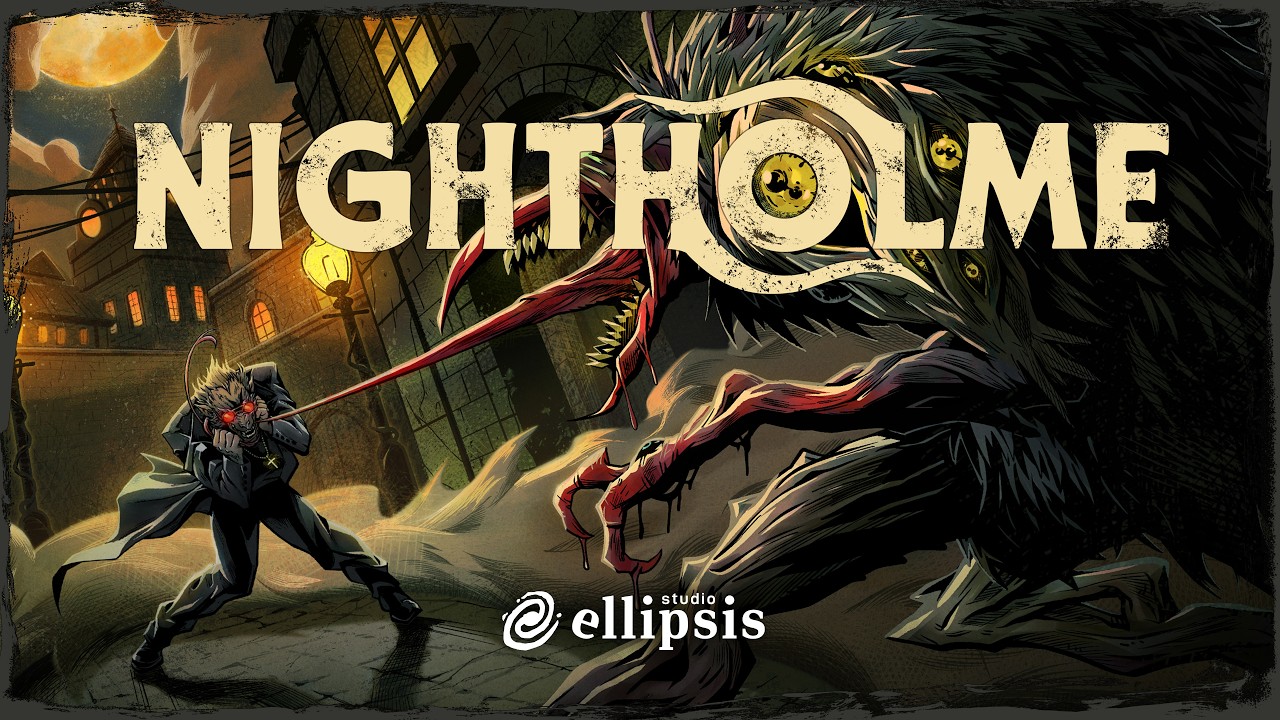
Nightholme is about transformation. It’s about impossible choices. It’s a corrupted power fantasy game. You take a potion and turn into a monster to fight monsters, but in doing so, you’re also becoming that which you hunt. And if you’re not careful, you can lose yourself to that. The game is about entering this corrupted world, fighting monsters and enormous bosses, then escaping with different elements that you can use to evolve and grow.
Michael D. McClellan
I checked Nightholme out online. It looks intense.
Alex Amancio
It’s a cosmic horror game, and it really pushes that concept to the limit. Absolute power corrupts absolutely. In Nightholme, you take a potion and you turn into a monster. There are two shapes: a lesser shape and a greater shape that you can navigate. Both are imperfect. Both are complementary. When you’re in the weaker shape, you have control, so you can set traps. You still have the powers of a monster and heightened perceptions, but you’re not as strong as you could be. When you take on the full form, you’re incredibly powerful, but you’re a creature. You can’t drink potions, you can’t use items, and you’re also very loud. So, you sacrifice control for power, and power for control, depending on the situation, without either form ever being perfect. And there’s no mana bar in the game because, as soon as you take the potion, you have all the power in the world.
Michael D. McClellan
So, to hunt monsters in Nightholme, you must risk becoming one?
Alex Amancio
Exactly. The problem is yourself. When you take on that power, you’re losing yourself. The game has a sanity bar that keeps going down. What happens when you use too much power and lose yourself? Well, you turn into what we call the “abomination,” the most powerful form you could ever imagine. So, now you’re creating a dichotomy in players’ minds. They’re thinking, “Oh no, I’ve lost my sanity. I’ve turned into this huge monster. Now I have two minutes to find my way back.” There’s a specific action you have to take. If you don’t, you lose all your gear, and the game is over. At the same time, you’re now this huge creature that can just break stuff. So, there’s a dichotomy between your human mind and your reptilian brain. One is jubilating, while the other is thinking, “Oh no, I’m losing my sanity.” If you’re unable to do what’s needed to regain your sanity and return to your normal form, you realize that you can no longer control the creature. The screen continues to grow darker until the human is gone. You’ve lost control of your mind. That monster, that huge creature, is now loose in the level, in the world, hunting other players. Now you have to deal with something in the world that’s preying upon players—something that used to be a player but is no longer. That’s the gist of what Nightholme is about.
Michael D. McClellan
On what platforms can we play Nightholme?
Alex Amancio
We’re going to make an announcement a little later this year, but during early access, the game will be released on Steam. This aligns with our core value of community. We’re showing people the game as it’s being built. We show them the pre-alpha. We let people see the cracks. We show them how the game is evolving. We want people to see how games like Nightholme are made and how things get fixed and improved. That feedback loop is so important because the more we show the audience how hard and complex it is to make a game, the more they’ll understand the reality. We really want the fan base to be part of the game’s development. In essence, they’re creating the game along with us.
Michael D. McClellan
Please tell me about your parent company, FunPlus.
Alex Amancio
FunPlus is a company primarily known for mobile games. I was contacted by FunPlus a few years ago and had a discussion with Andy Zhong, the CEO and founder, and Chris Petrovic, the Chief Business Officer. Honestly, we really hit it off. We had very similar views on the evolution of the gaming industry and the importance of IP within it. Andy really believes that the next major IP—think Star Wars—is going to come from a games-first studio. His thesis is, “Why not us? If we’re not trying, then we’re not in the game.”
Since I came on board, FunPlus has started working on a lot of projects that transcend the mobile genre. For example, there’s a game called Aniimo that you might have heard of. It’s making a lot of waves. It’s a game that takes the creature-collection genre to a whole different level. It’s what Pokémon should have been, in my opinion, 15 years ago. It’s just incredible. It’s a huge, open-world experience built around a systemic approach. You can turn into different creatures, and in doing so, you gain their powers and perspectives. That’s just one of the many new, ambitious projects FunPlus is working on, and Studio Ellipsis is part of that catalog. It’s the boutique studio wing of FunPlus.
Michael D. McClellan
Alex Amancio, one last question for you. If you had one piece of advice for other aspiring creatives, what would that be?
Alex Amancio
I would say perseverance. I would say perseverance. Perseverance is probably one of the top two things that you need to have in any creative industry. Perseverance means not only knowing you’re right and keeping at it until your work reaches an audience, but also continually improving. One of the best books on writing that I’ve ever read is On Writing by Stephen King. I’m not necessarily a fan of Stephen King’s books, but I very much respect his imagination and creativity, his process, the whole thing. On Writing is brilliant. It talks about his life and everything he went through to get to where he is. I recommend it not only for writers, but for anybody who wants to be creative. There is so much you can learn from reading it. Stephen King would collect letters of rejection, and he would not stop until he was able to break through. His perseverance really shines through in that story. Perseverance is the main attribute of any creative, in my opinion.
Michael D. McClellan
Alex Amancio, thank you so much for another amazing interview.
Alex Amancio
It’s always a pleasure. It’s always super fun to talk with you.

- World Builder – The Alex Amancio Interview - November 24, 2026
- Force of Nature – The Andrew Panay Interview - September 26, 2026
- Mario Andretti – Full Throttle - February 4, 2024
